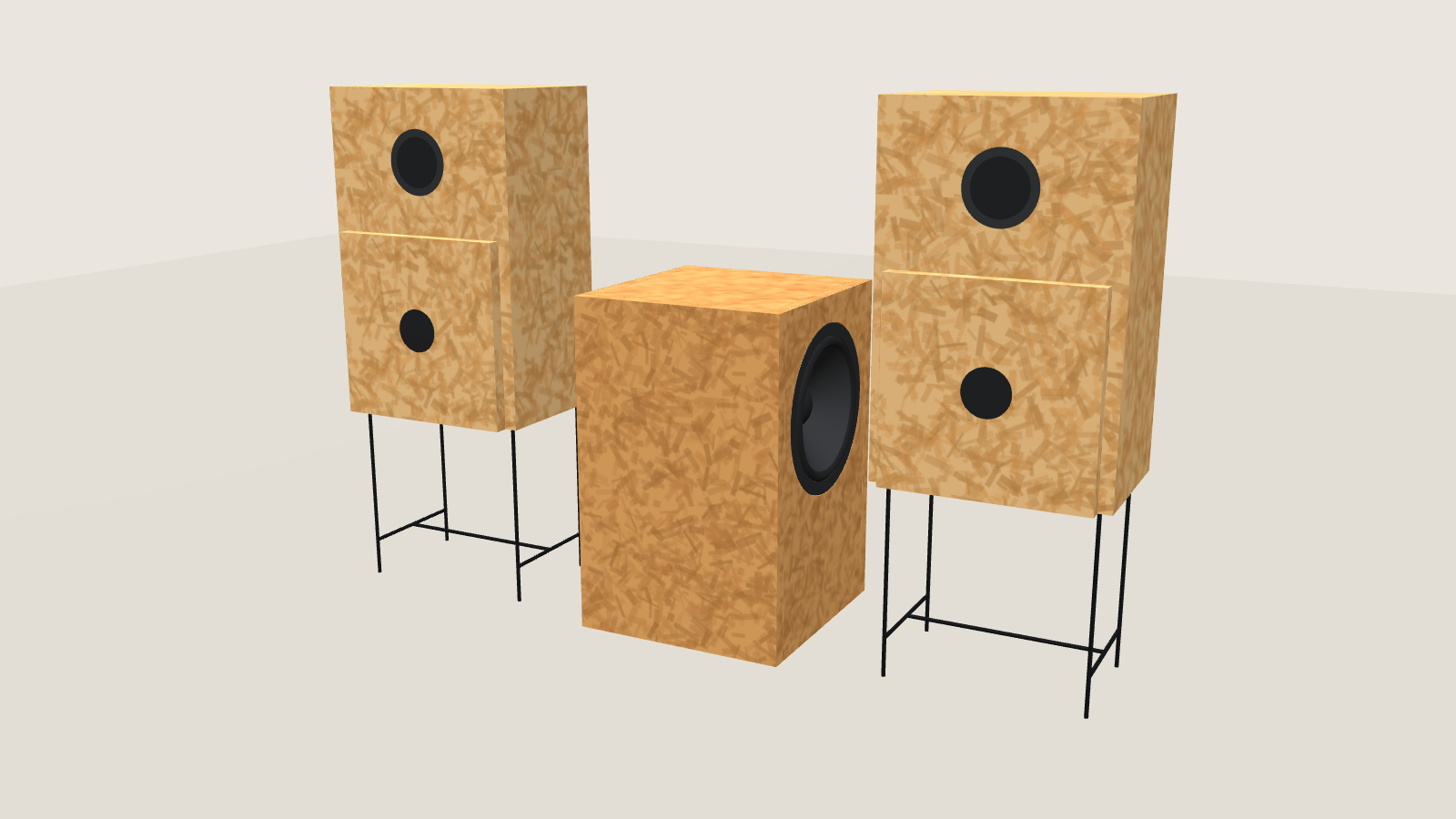
Le Petit Sub
Le Petit's bigger twin: a sealed subwoofer with two opposed 10″ drivers, built from one sheet of OSB with exactly Le Petit's 340 × 530 front.
All files, drawings and scripts: https://github.com/1704audiolabs/le-petit-sub · part of 1704 Audio Labs — Measure & Taste
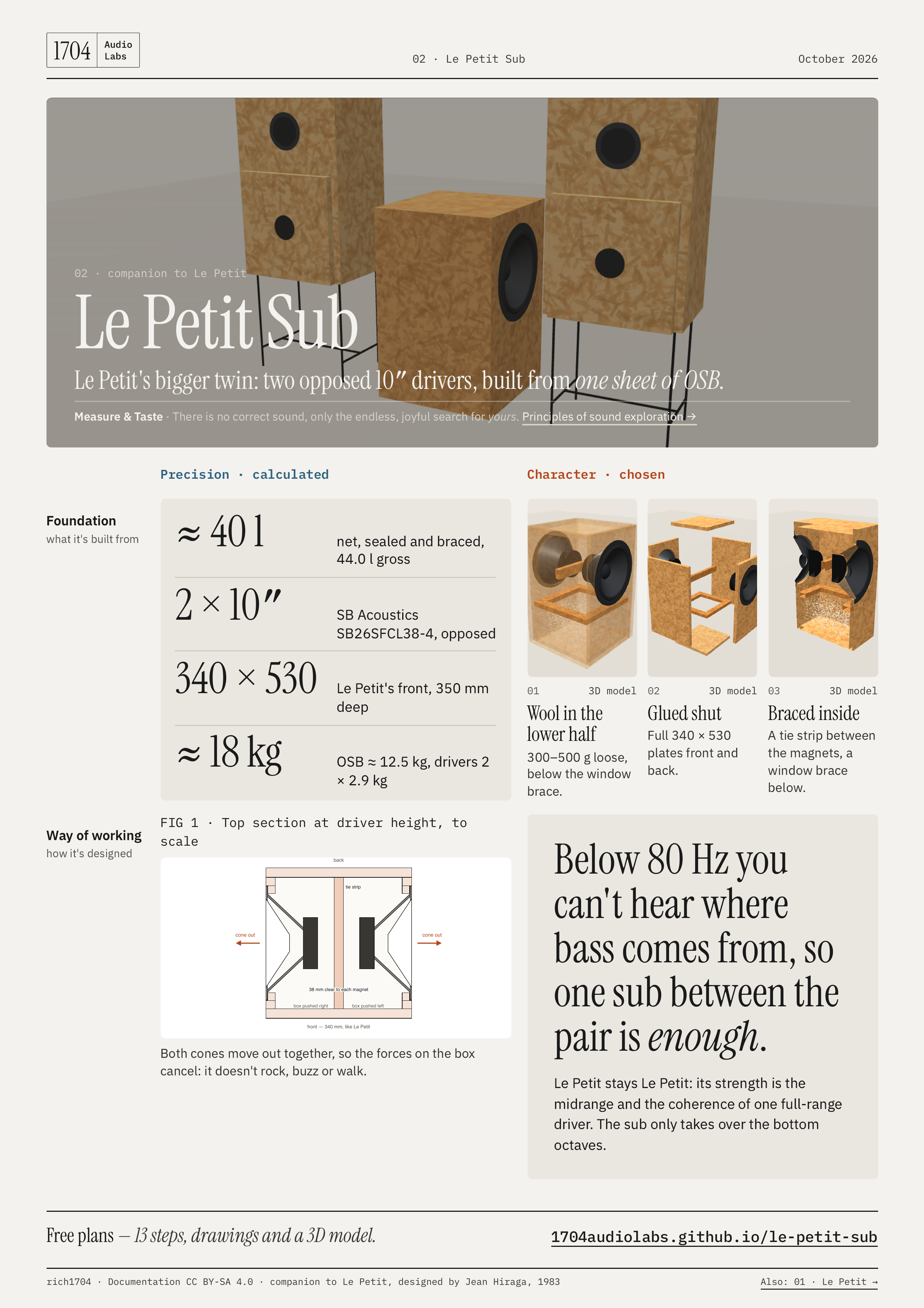
One-sheet · A4
The whole project on one page — what was calculated, what was chosen and how to build it. Open the one-sheet →
The companion to Le Petit.
In short
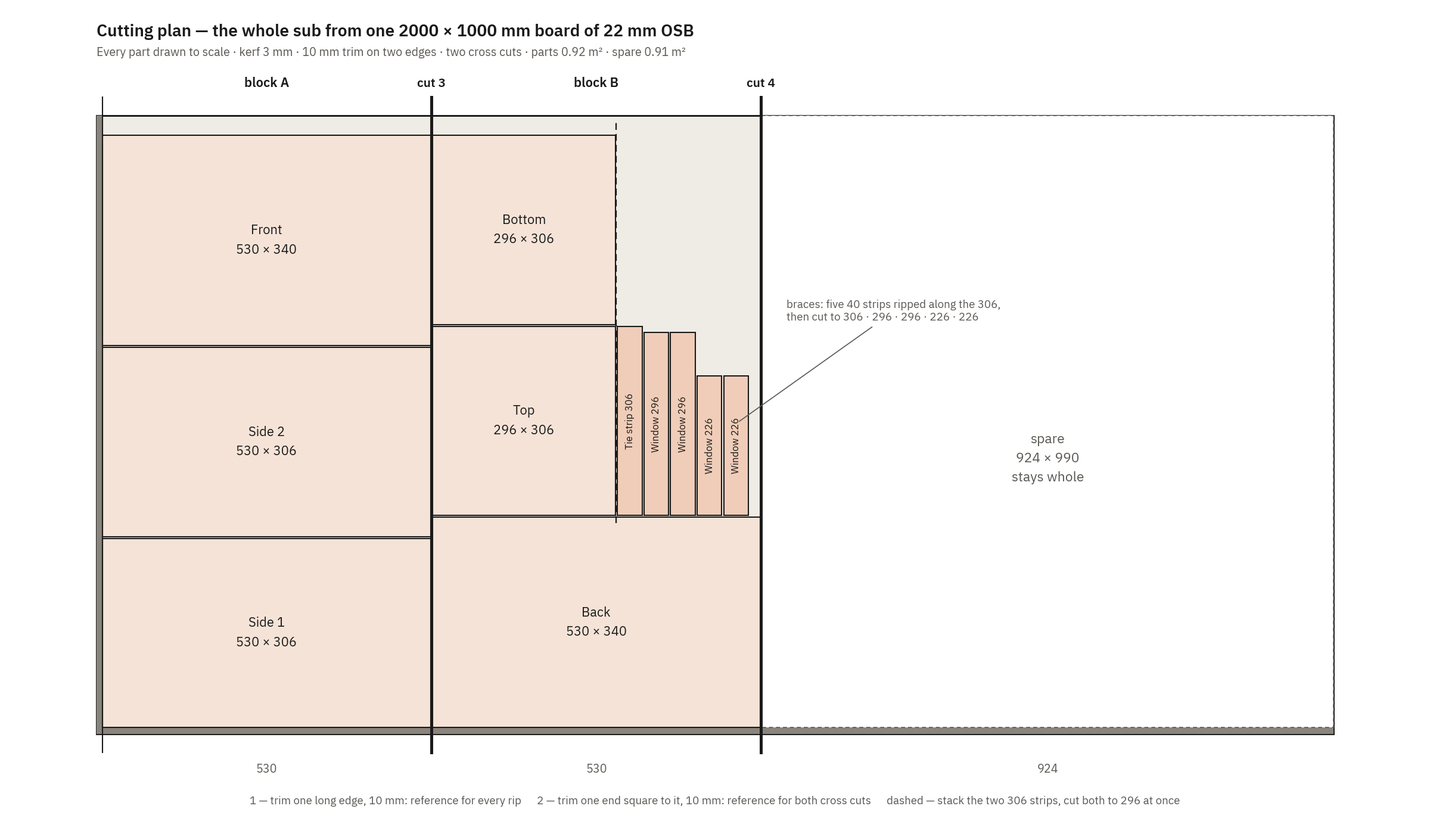
- One 2000 × 1000 mm board of 22 mm OSB, two cross cuts, and a 924 × 990 piece stays whole.
- Le Petit's front, 340 × 530, and its plain butt-jointed OSB: next to the pair it reads as one set.
- 2 × SB Acoustics SB26SFCL38-4 (10″) in the side panels, back to back: the forces on the box cancel, and the front stays a quiet face.
- Sealed, ≈ 40 l net, braced, glued shut; the drivers sit flush and come out from outside.
- One OSB board, two drivers and a handful of small parts. Every drawing is generated from one file of dimensions.
Contents
Why a sub · How it works · 3D model · Build it · Parts · Repository map · Credits
Why a sub
- Le Petit stays Le Petit. Its strength is the midrange and the coherence of one full-range driver. None of that changes: the sub only takes over the bottom octaves, below about 80 Hz.
- The 4″ drivers get cleaner. Freed from the deep bass, the small cones stop fighting for excursion they don't have.
- Real bass from a small box. Two 10″ cones move about as much air as one 14″, in a box with Le Petit's front. Below 80 Hz you can't hear where bass comes from, so one sub between the pair is enough.
- It looks like part of the set. Same front size, same OSB, same plain edges. The drivers sit in the sides, so from the front it's a quiet block next to the pair.
How it works
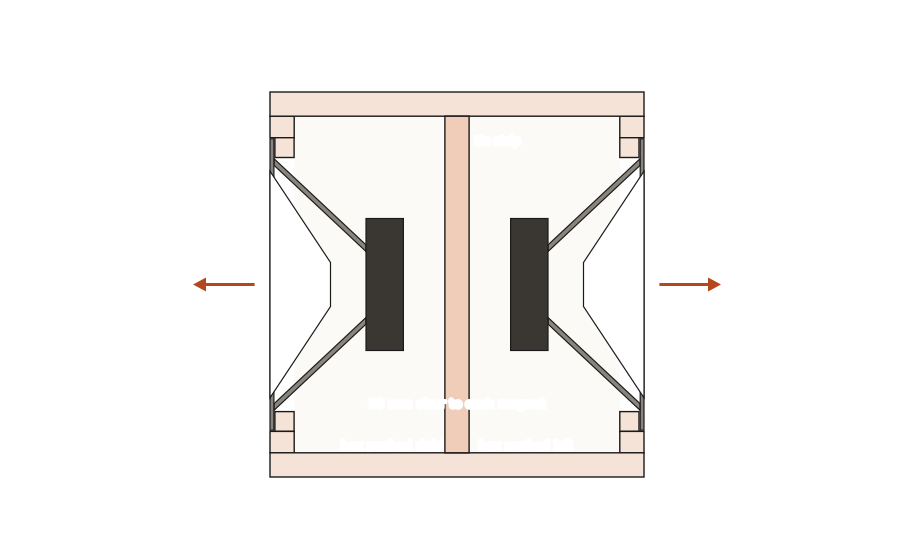
- Forces cancel. A moving cone pushes the box the other way. Two mirrored drivers with the same signal push in opposite directions, so the box doesn't rock, buzz through the floor or walk.
- Sealed, no port. No port noise, no tuning to get right, tight timing in the bass, and the air in the box holds the cones.
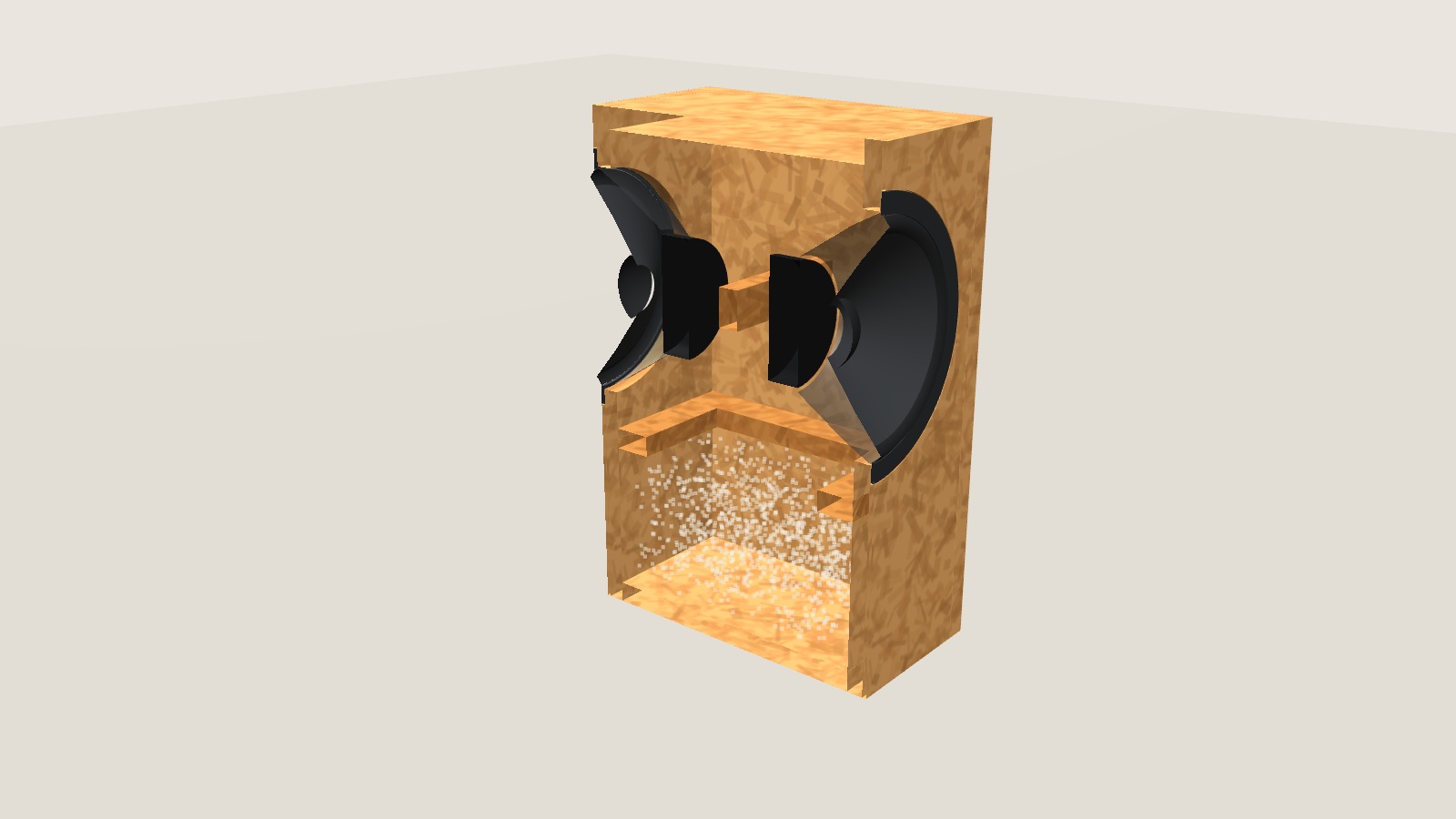
- Braced where the panels would flex. The forces cancel, the air pressure on the panels doesn't. A tie strip links front and back between the magnets — 38 mm clear of each — and a window brace just below the drivers ties all four walls.
- Flush drivers. The 3.56 mm frames sit in a 4.5 mm recess on gasket tape, so the sides stay as plain as Le Petit's front.
3D model
Turn it, look inside, cut it open, explode it, play the cones — open the 3D model.
| Cut open | Exploded |
|---|---|
 |
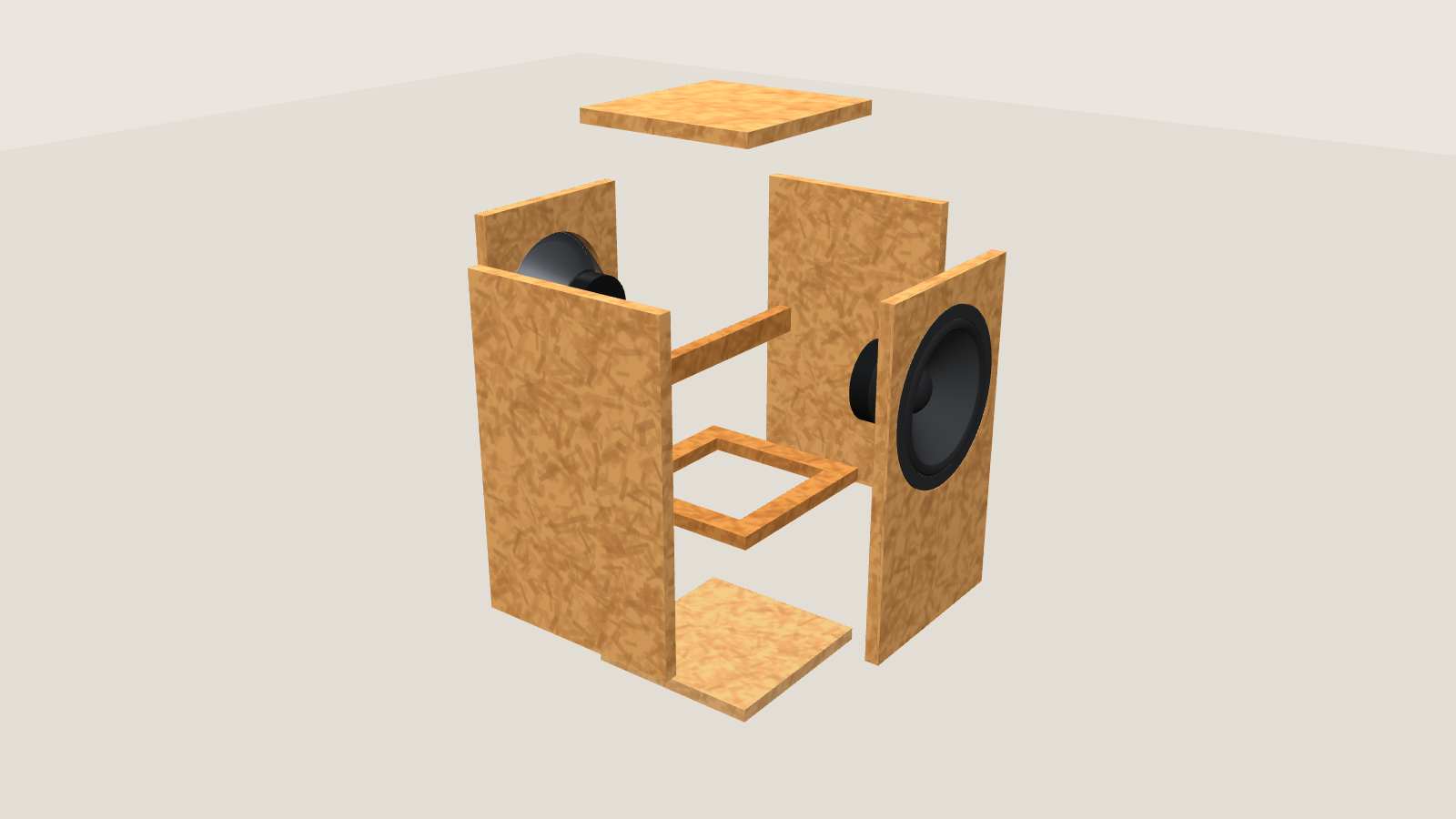 |
Build it
| Specification | |
|---|---|
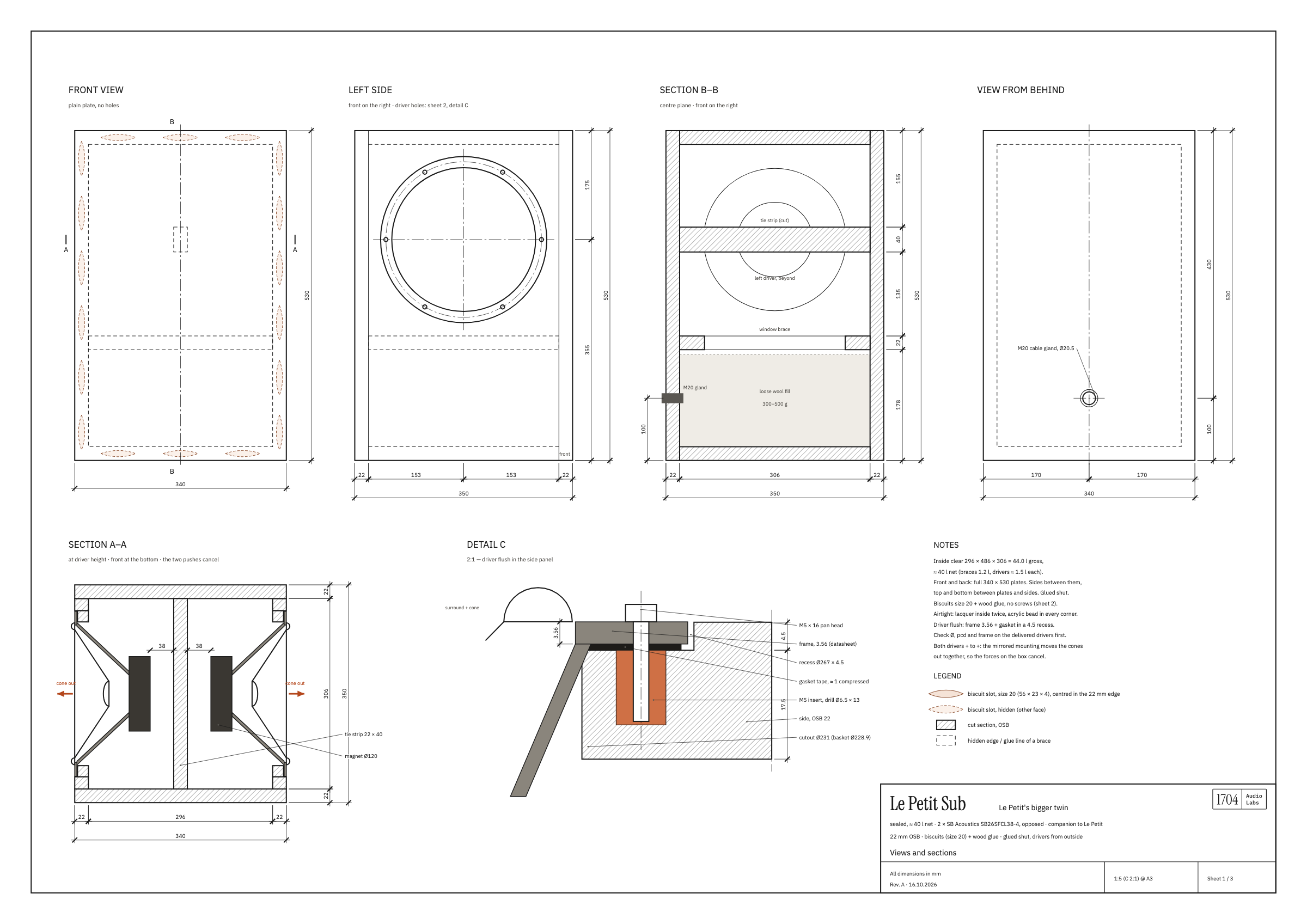
| Box | 340 × 530 × 350 mm outside (W × H × D), 296 × 486 × 306 inside = 44.0 l gross, ≈ 40 l net |
| Material | one 2000 × 1000 mm board of 22 mm OSB, square edges |
| Construction | front and back are full 340 × 530 plates over everything; sides between them, top and bottom between plates and sides — biscuits (size 20) + wood glue, glued shut |
| Drivers | 2 × SB Acoustics SB26SFCL38-4, 10″, 4 Ω, flush in a Ø267 × 4.5 recess, Ø231 cutout, 6 × M5 inserts each |
| Bracing | tie strip 306 × 40 on edge between the magnets; window brace of four 40 × 22 strips, 330 below the top |
| Damping | 300–500 g loose wool, lower half and corners |
| Wiring | 4-core cable through an M20 gland in the back, one pair per driver, both + to + |
| Weight | ≈ 18 kg: OSB ≈ 12.5 kg, drivers 2 × 2.9 kg |
Everything from one board, two cross cuts:
The building plan — three A3 sheets with every dimension, cut list, holes, biscuit positions and assembly order: the building plan.
The build guide in 13 steps — all of it here: cut, driver holes, seal, biscuit slots, the open box, braces, corners, back plate, last corners, finish, cable and wool, drivers, leak test.
The driver and the box — mounting dimensions from the datasheet, volume, bracing and damping: Driver and box.
Check before you cut. The driver dimensions come from SB Acoustics' datasheet, marked preliminary data. Rout a test recess in scrap and drop a delivered driver in before you touch the side panels, and measure your OSB — if it isn't exactly 22 mm, the inside sizes change with it.
Parts
| Qty | Part |
|---|---|
| 1 | 22 mm OSB, one 2000 × 1000 board (0.92 m² used) |
| 2 | SB Acoustics SB26SFCL38-4, 10″, 4 Ω |
| 12 | M5 inserts + M5 × 16 screws |
| gasket tape, 300–500 g wool fill | |
| 4-core speaker cable, M20 cable gland |
Repository map
docs/
├── one-sheet.md             the whole project on one A4 page
├── 3d/index.html            the interactive 3D model (three.js), with the Le Petit pair
├── 01-build.md              build guide, 13 steps, parts list, cutting plan
├── building-plan.md         the building plan: three A3 sheets, cut list, holes, joints
├── 02-driver-and-box.md     driver mounting data, volume, bracing, damping, why these choices
├── plans/                   building-plan sheets (SVG + PNG) and the cutting plan
└── assets/                  3D stills, the diagram, one-sheet image, site styles
tools/
├── sub.py                   every dimension and driver value, plus the geometry checks
├── make_building_plan.py    the three A3 sheets
├── make_cut_layout.py       the cutting plan
├── make_diagrams.py         the diagram
├── shoot_3d.py              stills of the 3D model for this README
├── svg2png.py               PNG previews of the sheets (headless Chrome)
└── sync_index.py            the website's home page from this README
overrides/                   page templates: home cover, one-sheet
To regenerate everything after changing a dimension in tools/sub.py: make (needs Python 3 with
matplotlib, and Chrome for the previews and the 3D stills).
Credits and license
The sub is designed to sit next to Le Petit, Jean Hiraga's design (L'Audiophile no. 29,
1983) — see Le Petit. Driver data:
SB Acoustics' SB26SFCL38-4 datasheet. Documentation, drawings and the 3D model: CC BY-SA 4.0;
the scripts in tools/: MIT. Details: Credits.